

Across financial services, the conversation around AI has moved on.
Whether to adopt AI is no longer the question. How to turn ambition into repeatable execution is.
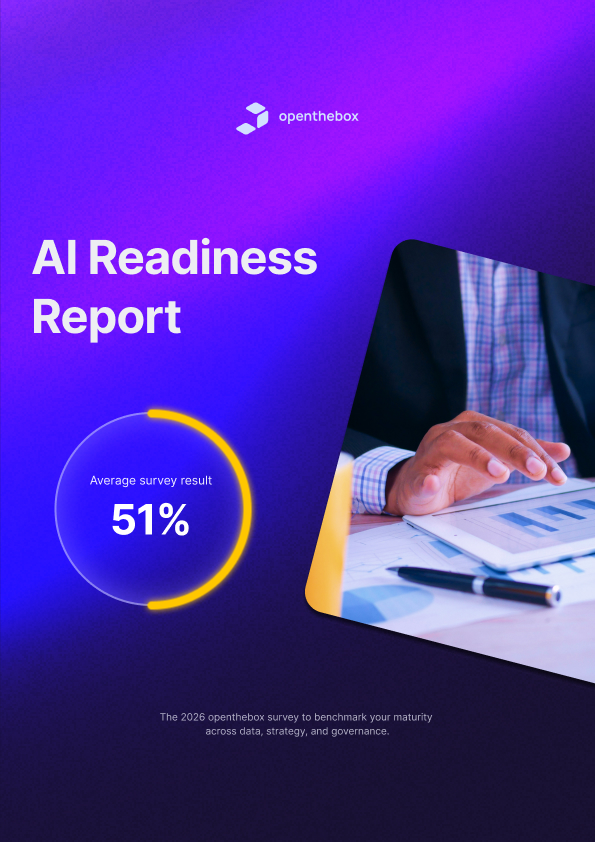
That is the central insight from openthebox’s AI Readiness Survey on AI readiness in financial services, grounded in input from 80 senior decision-makers across Belgium and the wider Benelux. The perspectives captured come from executives and leaders with direct responsibility for strategy, investment, and transformation, reflecting how AI is being approached where decisions are actually made.
What emerges is a data-backed view of an industry that understands AI’s importance, feels growing competitive pressure, and is actively investing. Yet despite this momentum, most organizations remain caught between experimentation and integration, with execution consistently lagging ambition.
AI Is in Use. Embedded AI Is Still the Exception.
AI adoption is no longer theoretical. Most organizations are already deploying AI in some form, often through pilots, targeted initiatives, or productivity-driven use cases. But scale remains elusive.
More than 70% of organizations are still exploring or piloting AI rather than running it as an embedded, organization-wide capability. This creates a familiar pattern: increasing activity without durable execution.
AI exists alongside the business rather than inside it. Decision-making, processes, and accountability structures often remain unchanged, limiting AI’s ability to compound value over time.
Competitive Pressure Is Accelerating Adoption
What’s pushing AI forward is not experimentation for its own sake, but pressure.
Nearly two-thirds of senior leaders report direct competitive or market pressure to adopt AI. As a result, investment is becoming unavoidable. Almost three quarters of organizations have already allocated budget to AI initiatives, signaling that ambition is backed by real spending.
The focus of this investment is pragmatic. Organizations are prioritizing internal productivity, analytical efficiency, and decision support before attempting broader transformation. The intent is clear: prove value, then scale.
Data Readiness Is the Dominant Constraint
Despite growing investment, progress consistently stalls at the same point: data.
Nearly three quarters of organizations acknowledge they are not fully data-ready for AI. Data is present, but fragmented across systems, inconsistent in quality, or difficult to access at scale. This fragmentation limits reuse, undermines trust in outputs, and keeps AI initiatives confined to isolated successes.
From our experience working closely with financial services organizations, the challenge is rarely a lack of data. More often, it is the difficulty of creating a coherent, trusted view across fragmented sources. When context is incomplete or inconsistent, AI outputs struggle to translate into confident decisions.
The implication is structural. Without coordinated progress on data foundations, AI remains dependent on local workarounds rather than becoming a repeatable organizational capability.
As Dr. Eva Blondeel, postdoctoral researcher at Ghent University and expert on Generative AI in finance, puts it:
“The survey results highlights a familiar gap: plenty of AI ambition and pilots, but limited maturity. The next step won’t come from more tools. It will come from fundamentals: data readiness, governance, and broad upskilling so people can use AI critically and confidently, and organisations can realise transformational value.”
Her perspective underscores that progress requires organisational foundations, not just technology.
Skills and Governance Lag Behind Intent
Technology access is rarely the issue. Organizational readiness is.
When leaders are asked what holds AI adoption back, the most frequently cited barrier is the lack of skilled people. This is followed by the absence of clear scaling strategies and persistent data quality challenges. Rigid IT environments, governance complexity, and internal resistance further slow progress.
At the same time, governance awareness is rising. Leaders understand the importance of risk management, accountability, and compliance in AI deployment. Yet operational frameworks often lag intent, leaving organizations reactive rather than deliberate in how AI is governed and scaled.
What Distinguishes Stronger Performers
The survey reveals a clear execution gap.
Organizations that progress faster tend to focus on concrete use cases with defined business impact. They embed AI into decision processes rather than treating it as a side experiment, and they accept imperfect conditions in exchange for learning and speed.
Less mature organizations remain locked in pilot mode. They overestimate readiness, wait for structural certainty, or delay execution until conditions feel “right”, often allowing complexity to compound rather than resolve.
The difference is not belief in AI. It is the ability to integrate it.
From Experimentation to Advantage
The next phase of AI adoption in financial services will not be driven by more tools or larger models.
It will be defined by execution.
Organizations that move ahead will focus on:
- Strengthening data foundations before expanding AI use cases
- Building skills that connect AI capability to business decision-making
- Translating governance awareness into operational ownership
- Shifting from isolated initiatives to repeatable execution across teams
- Decide whether to buy or build with a clear rationale
AI is already reshaping financial services. The question is no longer who is experimenting, but who is building the foundations to sustain advantage.
About the AI Readiness Survey
The openthebox AI Readiness Survey benchmarks AI maturity across data, skills, governance, and execution in financial services. It reflects input from senior leaders responsible for strategic decisions and transformation initiatives, offering a grounded view of where the industry stands heading into 2026.
The survey was conducted using Pointerpro, a survey and assessment platform that enabled structured scoring, benchmarking, and consistent measurement across dimensions such as data readiness, governance, skills, and execution.

.png)
.png)


